Archive for the ‘behavior’ Category
Greta seems to have enough of mothering
The pups are huge and very advanced! Which is good as Greta seems to have had enough of mothering. I had her outside with me the entire morning (nearly 5 hours) and not once did she seem stressed about being away from her puppies. She ran around joyfully, sniffing and exploring. She tired to get Hermes to play by body slamming into him, but he wasn’t as into being outside as she was. She seemed to thoroughly enjoy herself. In fact, when I returned her to the puppy room I expected her to be happy to see her pups as she hadn’t nursed them at all. However, when I went back into the room a bit later she still hadn’t nursed them! That was at least 7 hours without nursing! And her teats were really taught…I had to rather forcefully “encourage” her to nurse them. Now that she has, she is scratching on the door, desperate to get out again! I think Greta has had enough of mothering.
Greta’s puppies are growing
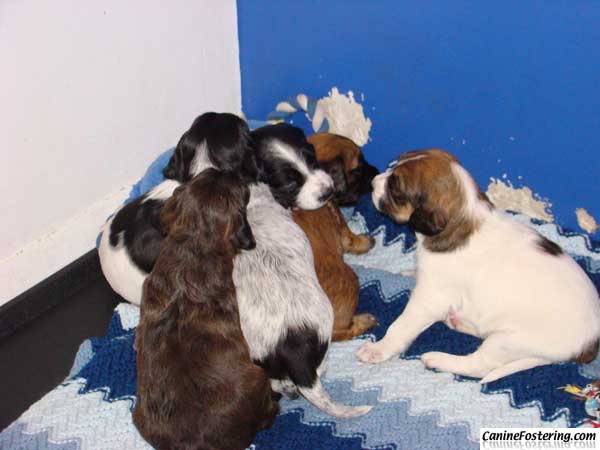 The puppies are really growing. In just the last two days they have begun to play. Prior to this, their days included eating and sleeping. That was it except for an occasional crawl around to get comfortable. Now after eating they spend about 10 minutes wrestling and playing with each other. There are also a lot of tail wags. Dogs wag their tails as a social cue, now that they are interacting it makes sense that this behavior is beginning to surface.
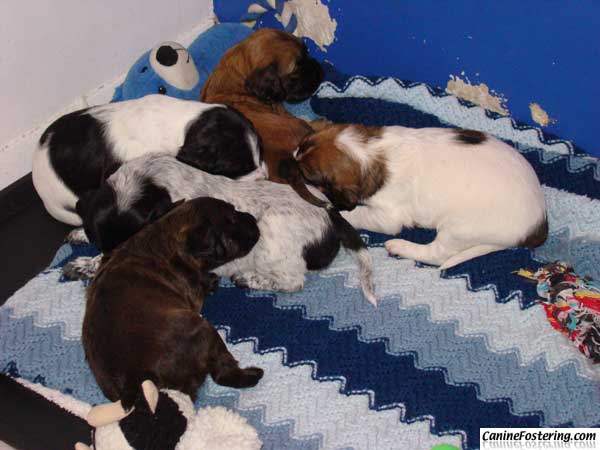 I’ve also begun to introduce food to them, first formula and now moistened kibble. They have the hang of the formula, but they cry and basically freak out when the kibble is in the bowl. I think I’ve mentioned how overly vocal (and dramatic) this group is, so any change, anything new, they really react to. Just imagine how they’ll be the first time I take them outside!
.
Thoughts about the Prong Collar
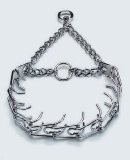
Sprenger prong collar
Many many people have very strong feelings about the prong (or pinch) collar. I have to admit it does look like a piece of medieval torture equipment. It looks dangerous and almost violent. But it works like a dream on many many dogs.
Recently, in one of my classes I had a student who also happens to be a working veterinarian, who has a very rambunctious, very strong dog she recently adopted from rescue. She came to class with a head halti, the training device that covers the muzzle of the dog and helps to control the dog’s behavior by controlling their head, much like a bridle works for controlling a horse. While this tool is often very effective for some dogs it was not working for this dog. Her dog was lunging and jerking her all over the ring and the force of all that power was being absorbed by the dog’s neck. It was clear that she was becoming more frustrated and admitted after class that the halti wasn’t working. I suggested trying a prong but said she didn’t want to because she believed prong collars were “inhumane.” In my work as a trainer, I’ve learned that the best tool is the one that addresses the dog’s behavior problem with the least amount of force and that the owner feels comfortable and capable of working with. So, even though it was clear to me that the prong would likely work wonders, I spent time explaining ways she could make the head halti work for her and advised her to be more careful of how she worked with the halti.
The interesting thing is, I believe that she could have had success with my method of working with that tool. But it would have taken a LOT of work on her part to convey to the dog what behaviors were correct and which were not. It seems to me that a lot of dogs really just don’t understand that we’re frustrated with them when we yank them around by their leashes. It almost seems like they think it is a weird game we play. If you ever watch dogs play with each other you know how physical they are, how banging into and grabbing and jostling one another is all part of the fun. I really believe that most dogs being yanked around by their owners think that we’re having fun. To make the halti work for her in this case she had to make it crystal clear what behaviors were unwanted, and what ones were, and most importantly that this wasn’t a game but rather, work. This would take a lot of training sessions with impeccable timing and lots of attention. And frankly, most people want faster results or just don’t have the time to devote to this sort of thing.
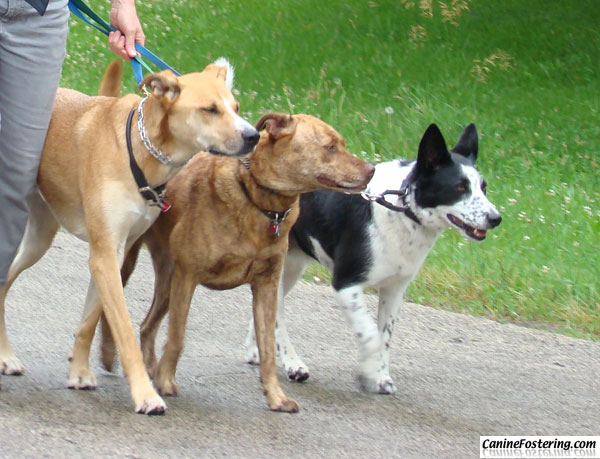 I don’t know what her specific situation is but this week in class she reached a sort of person limit. She was clearly frustrated and the dog was confused. When the handler and dog aren’t working as a team, no learning can happen. I gently suggested she just try out a prong for the class to see if she liked the results, and she agreed.
The results were, as you’d expect, remarkable. The behavior improved immediately and the handler became more calm, more confident and better able to train the dog. The dog’s focus on the handler improved and there was more eye contact between the two and therefore more opportunities to reinforce the focus and the work. I really watched this team and challenged myself to see if the dog had just “given up” or had lost its spark and was just complying out of fear. I didn’t see that. What I did see was the same dog, just a better, more focused, more self-controlled version. The dog seemed to finally understand the purpose of the whole training thing – it was like her mind said, “OH, that’s what you’re trying to tell me!” And when the handler expressed her pleasure at the dog’s behavior , the dog responded with pleasure right back. That’s the whole point of training in my opinion – to get on the same page with our dogs so we understand each other’s role and what is expected, and we know how to meet those expectations.
Moral to this story? Be careful of dismissing any training method or tool based on a story, a belief or an opinion. Keep your mind open and your focus on exploring what works. Trust your gut, but be honest with yourself. If your way of doing something isn’t working, ask for help and try something outside your comfort zone.
Letter from a frustrated dog owner
Here’s an exchange with a person who I’ve been working with recently to get their dog ready to take the American Kennel Club‘s Canine Good Citizen (CGC) test.
The question:
Kristin,
I’m really frustrated with where we are right now with S’s walking. As long as there are no distractions, he does fairly well. It’s something we could continue to work with. But if there are distractions, it all goes out the window. Last night he saw a squirrel within the first 100 yards and from then on he was pulling at the leash the whole time looking for the next squirrel or rabbit. I had been hoping to have a pleasant walk so I didn’t have any treats with me. But it really wouldn’t have mattered. You can get his attention with a “watch”, depending on how far away the distraction is, but as soon as you reward him for it, he’s back to the distraction.I’m really torn. I’d like to not have to be in training mode every time we go for a walk. Plus, to really do it right, I would need a whole bag of treats and would have to eliminate a meal. But if I don’t work with him, then I feel I’m reinforcing negative actions on his part. And my arm gets tired.
Plus I have no idea how you trained your dogs not to pee or poop on walks. It takes him less than a stride to get all four feet planted and he’s almost immovable then. Any ideas?
T-
And my response:
Dear T-
Not being next to you on the walk makes it hard for me to really get what’s going on. Maybe one of these nice late summer days we could do just that…? But, what you have to do is to keep up with the walking. I agree, treats aren’t really the answer. It is sort of about respect in my opinion…he believes his “work” (hunting critters – his job that he’s assigned himself in lieu of anything else to do) is more important than anything you have to tell him. So, somehow, we’ve got to get across that we have a different job in mind for him, a better one. But until he gets this, really understands this on his doggy level, he just doesn’t see the point in not doing it.
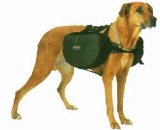 So, sometimes a harsher correction tool can help – a prong/pinch collar helps communicate in no uncertain terms that his behavior isn’t appreciated. The correction makes sense to him and is aversive enough (without being cruel) to get through to him that you want him to stop. Other options include giving him another job while on walks. That’s where a good back pack comes in handy. I recommend dog back packs from RuffWear. They make packs that I’ve seen and used and are acceptable. Fill the pack with up to 20% of S’s body weight and then go for the walk. It is amazing how this can change a dog. Plus, it’s hard to pee with a pack on.
So, try those things. However, your comment about not wanting to be in training mode with each walk is also a clue that you are losing your patience. I hope you come to accept that you kind of do need to always be in training mode when out with your dog. The training gets easier with time, but you can never just check out. It’s sort of like parenting – you’re always on, no matter how old they get. The older they get, the easier and less intensive the work is, but you still are the dad, always. So, try to find a place of acceptance with that fact. So, try to find a place of acceptance with that fact. This doesn’t mean that you have to tolerate a sore arm and a disrespectful dog, but you do have to continue training him his whole life.
Let me know if this helps.
-Kristin
Killers Among Us
We live with killers. Did you know that? Likely all of you reading this are sharing your home and possibly your beds with a known assassin. Even the sweetest among them are lethal and don’t you forget it for a second.
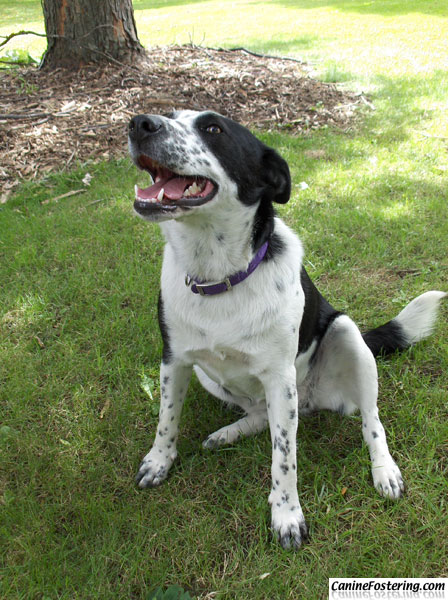 Today I saw first hand, the violence in action. My sweetest of all dogs, Bella is ruthless when her prey drive is in 5th gear. She has been hunting a nest of bunnies in our big yard for a week now. Well, actually, she hunted for a day and then has spent the rest of the week inside. I had hoped that the bunnies would be old enough by now to get away, but I was wrong. I heard the squeaking while I was moving large rocks. I started running while holding a rock, didn’t get far, stopped to drop the rock carefully and ran to her, the whole time yelling at the top of my lungs “LEAVE IT!!!” (which didn’t work, even for me, by the way). I thought I had saved it, it looked unharmed and wiggled in my hand, but then slowly, I saw it’s neck moving strangely and, well, I’ll save you the details. The bunny just slowly died. I stood there for some time, marveling at the beauty that goes so largely unnoticed by us – those velvety ears, the tiny nose, the beautiful fur, the perfect little face. It made me so sad, so very very sad, the waste of it, the loss of such a young life. I walked with it to the edge of the yard and gently slid it to the other side of the fence. Maybe some wild thing will eat a meal today. Maybe the life won’t be lost for nothing.
But then I realized the hypocrisy in me – I nearly rejoice when they kill chipmunks – the critters that ruin my gardens and my morning sleep – why do I have such an arbitrary view on the value of life? And as I turned to walk back to the house, Hermes joined me with a low head, sweeping tail and a smile that said clearly, “wasn’t that COOL? Dude, SO cool!” And I saw Bella in the distance, looking for more. They do what they do without all the stories in mind – they just do what they know to do – chase little furry things that move fast, but not fast enough.
Dogs teaching dogs
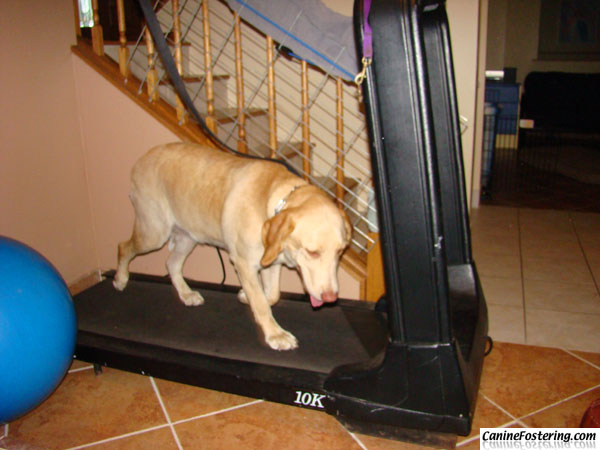
Otis likes the treadmill
We’ve had a busy week – Otis visited us for a week and overlapped with Teddy who is still here and now Jackson has joined him! So many male dogs … but everyone has gotten along great.
Otis is a hard worker and while he was here he asked for treadmill work every night. He asked by running around the basement, pushing the heavy leather furniture around with his head and then jumping on the treadmill and looking at me longingly. Every night he’d run for a half an hour – at 7.0 mph. I can’t keep up that pace myself, but he did. And little Teddy, nearly 5 months old, watched him. So, Otie has left and I miss him. He is a sweet, simple, joyful and accepting spirit. And I think Teddy misses him too.
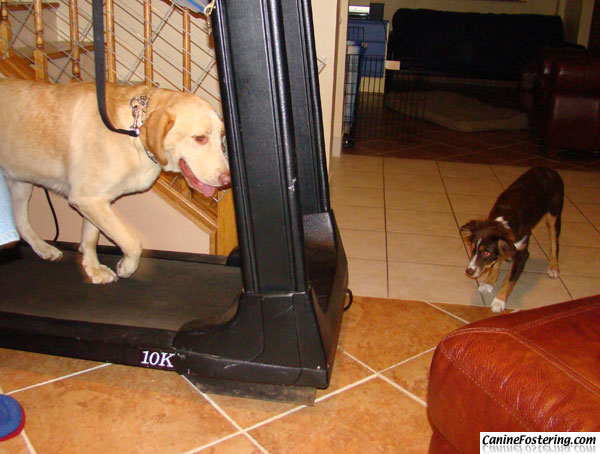
Teddy watching Otis on the treadmill
Tonight Teddy got on the treadmill all by himself. I ran to get his leash and some cheese and turned on the power. Ever so gingerly, Teddy started to walk, almost on tip toes. He did fantastic! It seemed to me that he had learned how not only to do it but to not be afraid of it from watching his buddy Otis! I was amazed.